10 days, 3 locations mobile tented safari Maun Airport to Kasane Airport
Moremi & Mababe & Savuti (Chobe)
Camp moves with you through three wildernesses — ground level, unhurried, and a world away from the lodge-and-fly-in circuit
Safari tour highlights
Exclusive campsites — the site is yours alone
Mokoro on the Khwai; night drives and walks in Mababe
Savuti’s lion prides — famous for hunting elephant
Max 7 guests on set dates; same guide throughout
At a glance
Set departure dates
Fixed dates — check schedule for availability
Daily game drives
Morning and afternoon drives throughout
Mokoro on the Khwai
Traditional canoe excursion on Day 4
Walking safaris
Guided walks in Mababe (conditions permitting)
Chobe boat cruise
River cruise on the Chobe, Day 10
Exceptional birding
Xakanaxa, Mababe and Savuti birdlife
Savuti lion prides
Famous elephant-hunting pride, up to 30 members
Elephant encounters
Bull elephants at the Khwai River
Mobile tented camp
En-suite camp moves with you between stops
Into the wilderness, the long way
Maun is the last proper town you’ll see for nine nights. From the Xakanaxa airstrip in Moremi Game Reserve, everything that follows is overland — your camp dismantled and reassembled ahead of you each time the group moves on. Three wildernesses. One guide throughout. No flights between stops.
Moremi opens the journey with predator-rich mopane woodland and the lagoons of Xakanaxa, where large buffalo herds draw multiple lion prides and wild dog are a daily possibility. Mababe Private Reserve sits between Moremi and Chobe — a little-visited concession where the Khwai River attracts large elephant bulls and night drives are permitted after dark. Savuti in Central Chobe is the finale: an ancient lakebed ringed by volcanic hills and home to one of northern Botswana’s most formidable lion prides, long known for hunting elephant. The journey ends with an afternoon boat cruise on the Chobe River before transfer to Kasane.
Departures run on set dates with a maximum of seven guests, staying at exclusive licensed campsites inaccessible to all but a handful of operators.
Day 1: Maun Airport to Moremi Game Reserve
A short charter flight from Maun to the Xakanaxa airstrip in Moremi Game Reserve — not included in the package rate but easily arranged; we are happy to book this for you — delivers you into the heart of the Okavango. Your guide meets you at the strip and the game driving begins on the transfer to camp. By the time you pull up at the first tent, you will already have seen something. The camp crew will have been there for hours; dinner will be ready when you arrive.
Moremi Game Reserve
Stay at: Letaka Mobile Tented Camp
Meals included: Dinner (D)
Drinks included: All local drinks included
Days 2 & 3: Moremi Game Reserve — Xakanaxa Exploration
Xakanaxa sits at the junction of mopane woodland, open floodplain and the permanent waterways of the Okavango — a convergence that makes it one of the continent’s most consistently productive game-viewing areas. The resident buffalo herd here numbers several hundred animals, its range overlapping the territories of at least four lion prides. Wild dog are a daily possibility. Each morning begins at first light; afternoons bring a second game drive into different terrain. The birding is exceptional throughout: wattled crane and slaty egret work the lagoon edges, African skimmer and fish eagle patrol the open water, and dozens of raptor species move through the mopane canopy.
Days settle quickly into a rhythm. A coffee and light breakfast around the fire before dawn, then straight out on the morning drive while predators are still active — typically four hours in the field before returning to camp at around 10 or 11am. Brunch is cooked fresh: camp bread from the fire, hot dishes, cold salads. The middle hours belong to the shade. A second drive goes out in the late afternoon as the light drops and the animals move again, returning to a lit campfire and dinner under the stars.
Moremi Game Reserve
Stay at: Letaka Mobile Tented Camp
Meals included: Full Board (B, L, D)
Drinks included: All local drinks included
Day 4: Moremi to Mababe Private Reserve — Mokoro & Moving Day
The travelling days on this safari are not lost days. The route from Moremi to Mababe follows the Khwai River north-east, and the morning begins with a mokoro excursion in the calm backwaters of the Khwai and Mbudi channels — a quieter, lower version of the Delta than anything seen from a vehicle. The convoy passes the Dombo Hippo Pools before crossing into the Mababe Private Reserve, a 50,000-hectare concession between Moremi and Chobe. The mature elephant bulls here — drawn to the permanent water of the Khwai River — are markedly more relaxed than the breeding herds encountered in the reserve itself.
Moving days have their own character. An early start, bags loaded before breakfast, which is taken somewhere scenic along the route — a riverbank, a clearing, wherever the morning produces something worth stopping for. Tea and cookies come at a natural pause; lunch under a shady grove of trees somewhere near the halfway mark. By the time the convoy arrives at the new campsite, the crew has been there for hours. The tents are up, the bucket shower is hot, and there is time to wash off the dust before afternoon tea and the first drive in the new area.
Mababe Private Reserve
Stay at: Letaka Mobile Tented Camp
Meals included: Full Board (B, L, D)
Drinks included: All local drinks included
Days 5 & 6: Mababe Private Reserve — Night Drives & Open Plains
Mababe is where the activity menu opens up. Night drives are permitted here — not in the national park, but in this private concession beyond its boundary — and they change the safari entirely. Genets, civets, spring hare and serval move after dark; the lion prides encountered by day take on a different quality when found by spotlight from an open vehicle. Walking safaris are available conditions permitting, your guide judging grass height and safety on the day. The concession enforces a strict maximum of 20 vehicles across the entire reserve at any given time, and the exclusive campsite means you are unlikely to encounter another group.
The daily rhythm in Mababe follows the same pattern as Moremi — dawn drive, midmorning brunch, afternoon drive — but with two additions that change the texture of the experience. Walking safaris go out on foot conditions permitting, the guide reading grass height and safety on the day; there is a different quality of attention when moving on the ground. And after the afternoon drive, the vehicles do not return to camp when the light fails. Night drives run here by spotlight, into ground that national park regulations put out of reach elsewhere on the route. The bush in Mababe after dark is its own thing entirely.
Mababe Private Reserve
Stay at: Letaka Mobile Tented Camp
Meals included: Full Board (B, L, D)
Drinks included: All local drinks included
Day 7: Mababe to Central Chobe — Crossing the Sand Ridge
Today’s drive is one of the more extraordinary in northern Botswana. The route crosses the Magwikwe Sand Ridge — the ancient shoreline of an inland sea that covered much of this landscape around ten thousand years ago. The ridge is deep sand: slow going, spectacular scenery. Beyond it lies the Mababe Depression, a shallow clay basin that floods seasonally and draws large numbers of birds and wildlife. The Savuti Marsh comes into view as the convoy approaches Central Chobe: an ancient lakebed ringed by volcanic outcrops that rise improbably from the flat Kalahari sands.
The longest and most distinctive drive of the route. The Magwikwe Sand Ridge is deep Kalahari sand — the ancient shoreline of a vast inland sea that dried up ten thousand years ago — and crossing it takes time. The pace is part of it. Beyond the ridge the Mababe Depression opens up: a flat clay basin that floods in the wet season and draws large concentrations of birds and game when it does. The Savuti Marsh and the volcanic Gubatsa Hills come into view on the approach to Central Chobe, a landscape that looks and feels markedly different from anything encountered in the previous six days.
Central Chobe National Park (Savuti)
Stay at: Letaka Mobile Tented Camp
Meals included: Full Board (B, L, D)
Drinks included: All local drinks included
Days 8 & 9: Central Chobe (Savuti) — Lions, Elephants & Rock Paintings
Savuti has a particular reputation earned across decades of wildlife documentaries. The lion pride here — fluctuating between 20 and 30 members — learned long ago to hunt elephant after dark, using numbers and the cover of night. Sightings of the aftermath, or occasionally the event itself, are possible. Cheetah are common in the open marsh; wild dog move through in the wetter months. The landscape is unlike anything seen earlier on this route: the Gubatsa Hills rise improbably from the flat Kalahari sand, volcanic and ancient, casting long shadows in the late afternoon light. Klipspringer pick their way across the upper rocks; the thermals above draw raptors that don’t appear elsewhere on the itinerary. A guided walk to ancient San Bushman rock paintings at the base of the hills adds a different dimension to the final exploration days.
Days in Savuti follow the same early-rise rhythm as the rest of the safari — dawn drive, brunch, siesta, afternoon drive — but the open flat landscape means sightings carry from a long way off, and drives here often run longer than planned. The guided walk to the Bushman paintings breaks the pattern on one of the two mornings: a slower, quieter start, reading a different kind of evidence of who has lived in this landscape across thousands of years.
Central Chobe National Park (Savuti)
Stay at: Letaka Mobile Tented Camp
Meals included: Full Board (B, L, D)
Drinks included: All local drinks included
Day 10: Savuti to Chobe River — Boat Cruise & Kasane
The Zambezi teak woodlands of the Chobe Forest Reserve open around you as the convoy heads north-east for the last time — the canopy here is different from anything on the route so far, and roan and sable antelope move through it in a way they rarely do in more open bush. The journey ends at the Chobe River, where a picnic lunch waits before the afternoon boat cruise. Elephant herds come down to drink along the bank; the boat moves quietly upstream into the light. The safari ends in Kasane.
Chobe River, Kasane
Departs: Kasane Airport
Meals included: Breakfast (B) & Lunch (L)
Drinks included: All local drinks included while at camp
Mobile camp & expert guide
This is a fully serviced mobile tented safari — a different proposition from a fly-in itinerary where you move between fixed lodges. Here, the camp itself travels with you: a format that puts you in remote wilderness areas that permanent infrastructure simply cannot reach, at a fraction of the cost of an equivalent fly-in journey. On moving days, the camp crew dismantles the tents ahead of your departure, drives to the next site and has everything rebuilt and ready before you arrive. You travel in a customised open-sided Land Cruiser with your guide and a maximum of six other guests throughout the entire nine-night journey. A safari chef accompanies the group and prepares all meals in camp. A charter flight from Maun to the Xakanaxa airstrip positions you at the start of the route — not included in the package rate, but we are happy to arrange this for you. All travel from that point is overland. Luggage is restricted to 20kg per person in a soft-sided bag, with no hard-sided cases.
Life in camp
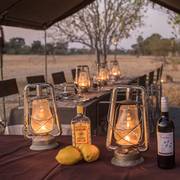
Mobile does not mean basic. Each tent is a spacious 4×3m Sahara-style canvas structure with a high roof, a solid-frame bed made up with mattress, sheets, duvet and pillows, and a private en-suite bathroom with a long-drop toilet and hot bucket shower at the rear. Paraffin lanterns light the tent and veranda after dark; a rechargeable LED lamp and side table sit inside. The camp is built and broken by a dedicated crew — by the time you return from the morning drive, everything that follows you on this journey is already packed and moving.
Evenings in camp are a large part of what people remember. Dinner is served under the stars at a laid table, cooked from scratch by a safari chef who travels with the group. Afterwards the fire stays lit, the guide stays up, and the conversation tends to run long. The sounds outside the canvas — lions calling across the marsh, hyena on the move, the odd snap of a branch nearby — are not a backdrop. They are the point.
There is no cell signal and no internet for the duration of the safari. This is not an oversight — it is part of what the experience offers. The vehicles carry 220-volt inverters for charging camera and torch batteries; beyond that, the outside world is on hold. Most guests find this one of the better aspects of the journey.
Why book this itinerary?
Few things are harder to find on a modern Botswana safari than genuine solitude. The campsites on this itinerary are licensed exclusively to a handful of operators — there are no other tents at your site, no neighbouring vehicles at sunrise, no one else in your section of the Savuti Marsh. With a maximum of seven guests per departure and the same guide throughout all ten days, you spend long enough in each wilderness to move past the standard sightings and into its actual rhythms. The mobile format means camp follows the seasonal conditions rather than sitting fixed in one spot year-round. The format suits anyone drawn to true wilderness immersion over the comforts of a permanent lodge — and anyone who finds the idea of falling asleep to lions calling across the marsh more compelling than a swimming pool and a room number.
The safari ends in Kasane in the late afternoon — many guests find it well worth adding a night or two on the Chobe River or crossing into Victoria Falls before heading home. Ask us about extensions.
Is this safari right for you?
Ideal if you want to cover serious ground — three distinct wilderness areas in ten days, each genuinely different from the last.
Ideal if you prefer a small, cohesive group over the anonymity of a larger lodge: the same guide and the same faces for the full ten nights.
If you’d prefer fixed lodges and light aircraft between camps, consider The Complete Botswana Fly-In — a longer fly-in itinerary covering four northern Botswana destinations.
Children must be aged 12 or older for set-date departures. Families with younger children are welcome on private departures — ask us for details.
Make an enquiry for this Botswana safari holiday
This safari runs on set departure dates with small groups. Get in touch to check availability or ask about a private departure.